
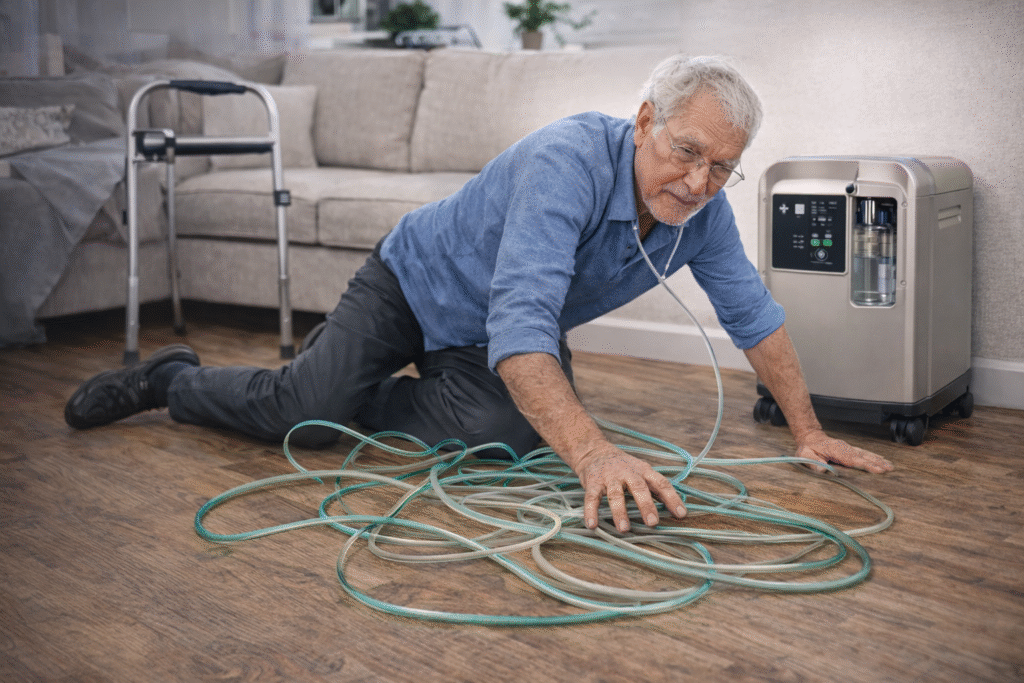
Oxygen Safety at Home: Why Trip and Fall Prevention Matters
When people think about oxygen safety, they usually think about fire risk first. That matters, of course. But there is another very real danger inside the home that gets less attention: tripping and falling over oxygen tubing. Official home-oxygen guidance from MedlinePlus and Veterans Affairs specifically warns patients to avoid tripping over oxygen tubing, because it can create a serious hazard during everyday movement around the house.
That risk is especially important for older adults and people with limited mobility. According to the CDC, falls are the leading cause of both fatal and nonfatal injuries in adults age 65 and older. More than 14 million older adults in the United States — about 1 in 4 — report falling each year. The CDC also notes that falling once doubles the chance of falling again.
These are not minor incidents. The CDC reports that older-adult falls lead to about 3 million emergency department visits and about 1 million hospitalizations each year. About 1 in 10 falls causes an injury serious enough to limit activity for at least a day or require medical attention, and about 37% of older adults who fall report an injury that required treatment or restricted activity.
The injury types can be severe and life-changing. The CDC states that falls are the most common cause of traumatic brain injuries, and nearly 319,000 older adults are hospitalized for hip fractures each year. Hip fractures, head injuries, broken wrists, shoulder injuries, and deep bruising can all turn one unexpected stumble into a long recovery, a hospital stay, or loss of independence. The trend is also getting worse: CDC data shows the age-adjusted fall death rate among adults 65 and older increased by 21% from 2018 to 2024.
What makes this so important for oxygen users is that falls often happen during ordinary daily routines, not dramatic accidents. The National Institute on Aging advises people to keep electrical cords near walls and away from walking paths, and to arrange furniture and objects so they are not in the way when walking. That guidance exists for a reason: the home itself becomes dangerous when items cross common pathways.
Oxygen tubing can add exactly that kind of obstacle. MedlinePlus tells patients to avoid tripping over oxygen tubing. Veterans Affairs gives the same warning. A hospital home-oxygen guidance document from University Hospitals Coventry and Warwickshire NHS Trust also warns that oxygen tubing can become trapped under doors or furniture, which may block oxygen flow and cause falls. In real life, that can mean tubing stretched across a hallway, pulled around a corner, looped near a recliner, or lying across the floor during a nighttime trip to the bathroom.
For many patients, that is where the risk starts. A foot catches the tubing. A walker rolls onto it. A family member steps on it. The tubing snags on furniture and pulls unexpectedly. None of those situations sound dramatic until someone loses balance. And for an older adult, a single loss of balance can mean a broken bone, a head injury, or a recovery that lasts for weeks or months. That is why home safety is not just about treatment. It is also about the physical setup of the home.
The good news is that not every fall risk is unavoidable. Public-health guidance consistently focuses on reducing hazards inside the home by clearing walkways, keeping cords out of traffic areas, and making daily movement easier and safer. That same principle applies to oxygen tubing. The more controlled and organized the tubing path is, the lower the chance that it ends up underfoot in the places people walk most often.
That is exactly the problem the Pure O2 wall mount system is designed to address.
By helping route oxygen tubing along the wall instead of leaving it loose across the floor, the Pure O2 system helps reduce one common household hazard for oxygen users: unmanaged tubing in walking paths. It helps create a cleaner, more organized route for the tubing through the home, especially in areas where patients move often, such as bedrooms, living rooms, hallways, and the path to the bathroom. That makes the environment easier to navigate for the patient, safer for caregivers and visitors, and more consistent with the same fall-prevention principles recommended by major health agencies. That connection is an inference based on established fall-prevention guidance and official oxygen-safety warnings about tubing hazards.
No product can eliminate every fall risk in a home. But reducing obvious, preventable hazards is one of the smartest and most practical steps a family can take. For oxygen users, tubing on the floor is one of those hazards. Managing that tubing better can mean fewer obstacles, clearer walkways, and a safer day-to-day routine.
For the patient, that can mean more confidence moving through the home. For family members and caregivers, it can mean greater peace of mind. And for anyone trying to make home oxygen use safer, cleaner, and easier, it is a simple improvement that addresses a real-world problem with real-world consequences